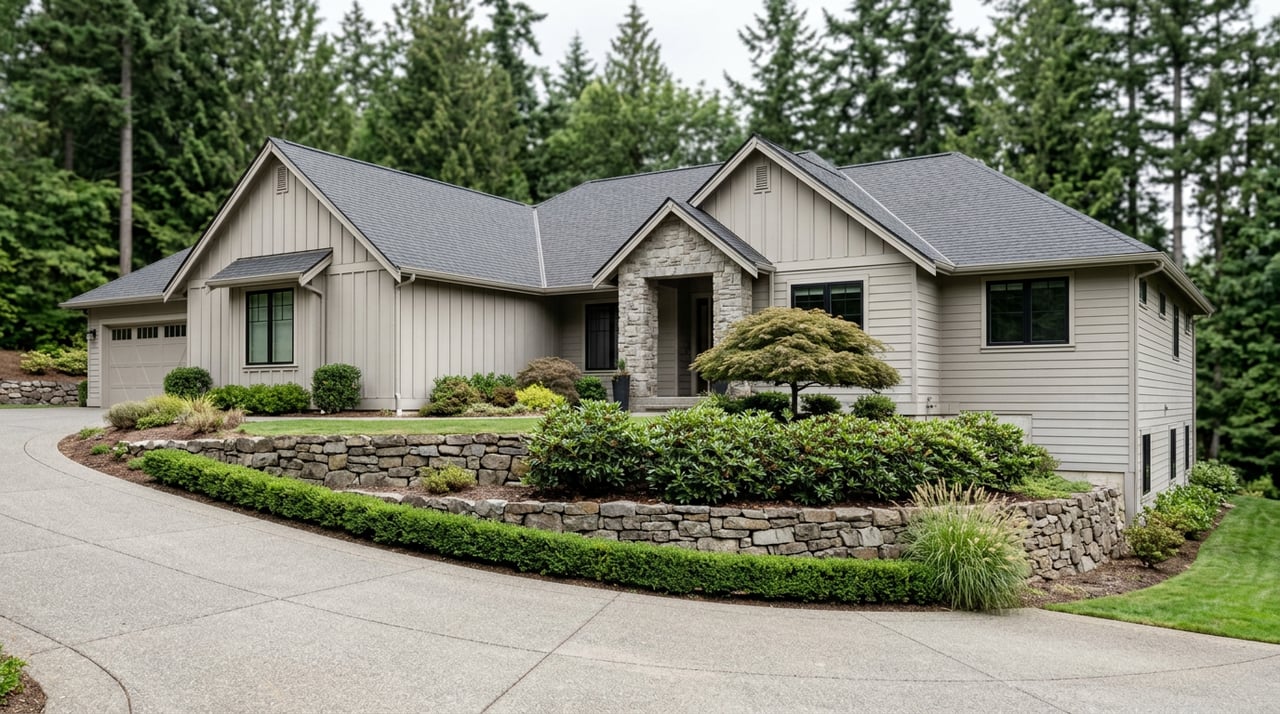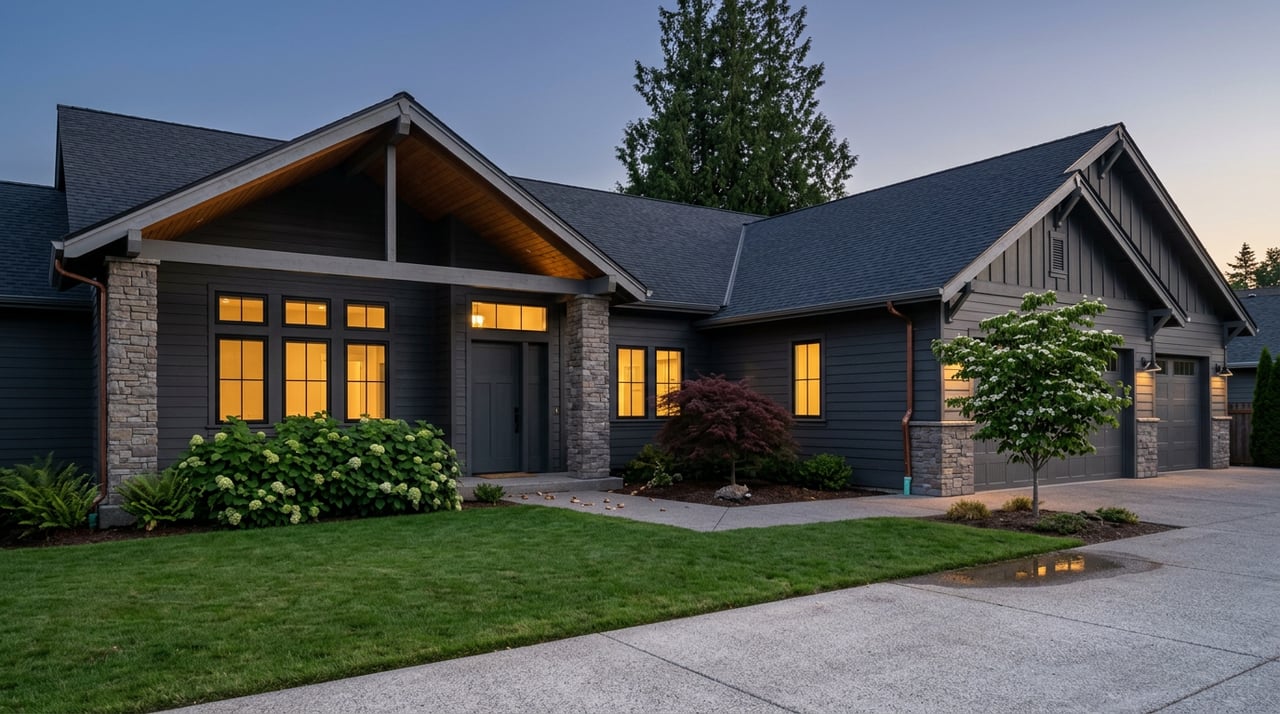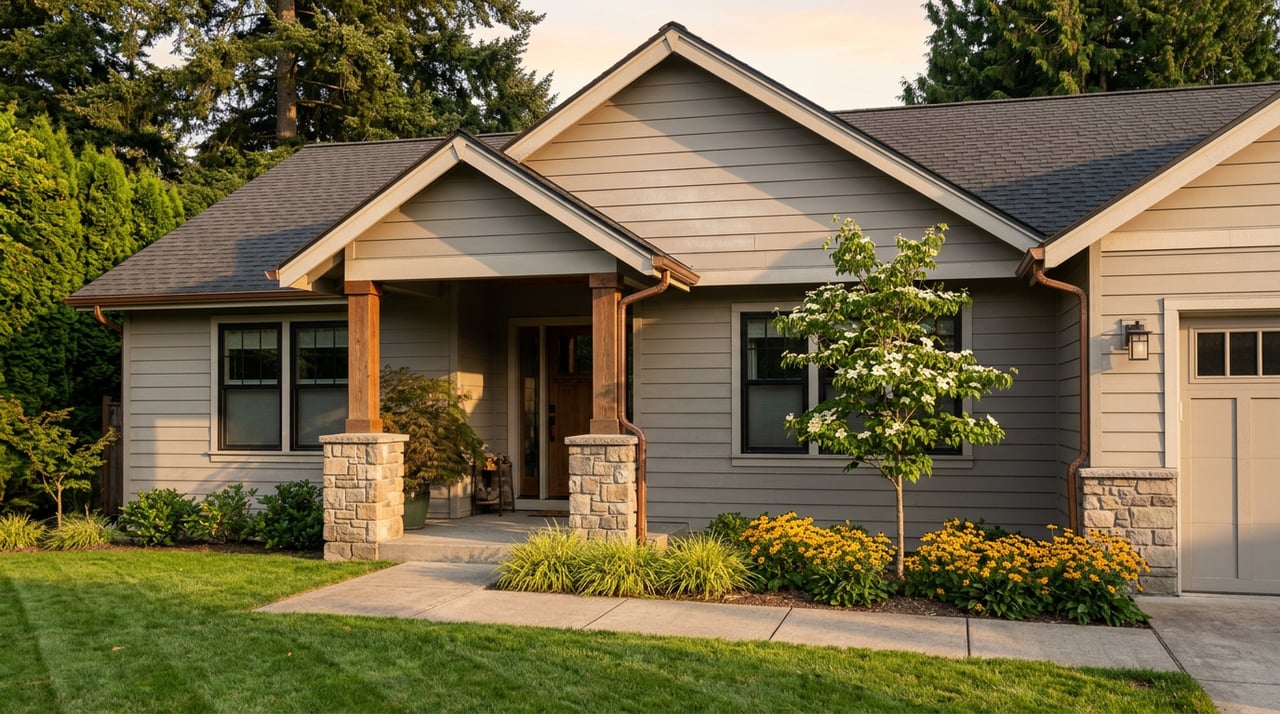
A buyer relocating to Portland's south suburbs pulls up Oregon City's median sale price, does the math against a budget, and starts touring. The first house is a 1908 bungalow three blocks from a historic elevator, with fir floors and a garage barely wide enough for a modern SUV. The second is a two-year-old townhome on the south edge of town, tankless water heater, two-car garage built to current code. Both are priced within a few thousand dollars of each other. Neither one tells you anything about the other.
That's the thing about a median. It's a single number standing in for a city that was, quite literally, built in layers. Oregon City sits on two levels separated by a basalt bluff, and a third layer of brand-new subdivisions has grown up on the flatter land beyond both of them. Shop the median without knowing which layer you're in, and you'll spend a Saturday touring houses that have almost nothing in common except a shared zip code.
What the Number on the Portal Actually Covers
As of the three months ending in May 2026, Oregon City's median sale price sat at $579,000, down about 1.1 percent from the same window a year earlier. The average sale price the following month came in at $565,000. Homes are moving fast for a market that isn't showing price growth: roughly 21 days on market on average, with sellers fielding about three offers per listing. Sales volume is climbing even as prices hold flat. Oregon City saw 126 closings in May 2026, up from 102 in May 2025, a jump of about 24 percent. Price per square foot rose slightly too, to $316, up 1.3 percent year over year.
Read as a single headline, that looks like a normal, moderately competitive suburban market. Read as a blend of three very different products, it starts to make more sense why buyers describe the search as confusing. Here's the breakdown as it actually plays out on the ground:
| Tier | Where you'll find it | What's typically for sale | Vintage | Price signal |
|---|---|---|---|---|
| Bluff-top historic | McLoughlin neighborhood, above the Municipal Elevator | Original and remodeled bungalows and Craftsmans side by side | 1880s to 1930s | Spans the citywide median, with wide swings depending on remodel |
| Established mid-city | Neighborhoods between the bluff and the South End | Mostly resale housing stock | 1960s to early 2000s | Clusters near the citywide median |
| New construction, South End | Serres Farms | Townhomes and detached homes, builder-finished | 2023 to 2026 | Townhomes in the high $400,000s to mid $500,000s; detached homes from $671,000 to $1,099,000 |
| New construction, South End | Riverstone | Larger detached homes, builder-finished | 2023 to 2026 | Starting at $1.2 million, with current community pricing from $1,376,000 |
Two of those rows sit well above the citywide median. That's the math behind the confusion: enough resale volume in the historic and mid-city tiers pulls the blended number down, even as an entire new-construction layer sells for double it.
Why a Bluff Splits the City Into Two Different Neighborhoods
Oregon City's geography is not subtle. Singer Hill Bluff rises roughly 100 feet above the Willamette, and for most of the city's history that grade was the difference between the business district at river level and the residential neighborhoods on top. Getting between the two meant a long flight of stairs until 1915, when the city built a water-powered elevator to carry people up the bluff. A concrete and steel replacement went in in 1955, and it's still running today, the only outdoor, city-owned elevator of its kind in the country, added to the National Register of Historic Places in 2014.
The McLoughlin Promenade runs along the top of that same bluff, a walking path built by WPA crews between 1936 and 1939, also on the National Register. Homes along and near it are some of the oldest in the city, sharing the neighborhood with houses that predate the Municipal Elevator itself.
That's the split a median can't show. A bluff-top listing isn't competing on lot size or garage width. It's competing on walkability to a historic downtown, proximity to a working piece of infrastructure that doubles as a landmark, and a housing stock where the range between an untouched original and a full gut remodel can be enormous even on the same block. The basalt that makes up the bluff is roughly 2.5 million years old, hard enough that local excavation contractors treat foundation work up there as a different job entirely from digging in the softer river-bottom soil below. That's not a detail most buyers ask about, but it explains part of why renovation costs and timelines vary so much between a bluff-top remodel and a South End new build.
The New-Construction Layer the Median Doesn't Reach
South of downtown, Oregon City looks like a different market because it is one. Serres Farms is currently selling townhomes in the high $400,000s to mid $500,000s and detached homes from $671,000 up to $1,099,000. A short distance away, Riverstone starts at $1.2 million, with current builder pricing from $1,376,000. Neither community shows up meaningfully in a citywide median built mostly from resale volume, because new construction is a smaller share of total transactions even in a market adding inventory as quickly as this one.
For a buyer comparing Oregon City to other Portland-metro suburbs, that matters. If the search criteria are new construction, a warranty, and a garage sized for two modern vehicles, the relevant comparison isn't the citywide median at all. It's Serres Farms and Riverstone pricing against equivalent new-build communities elsewhere in Clackamas County.
Further out, the Park Place Concept Plan describes where the next wave of that supply is headed. The plan covers roughly 500 acres added to the region's urban growth boundary back in 2002 and lays out 1,459 dwelling units across two mixed-use neighborhoods, plus commercial nodes and community space. It's worth understanding as a framework for where growth is planned, not as active inventory a buyer can tour this year.
The Riverfront Is Building a Fourth Layer, Slowly
The most significant long-term change to Oregon City's housing map is happening at the old Blue Heron paper mill site on the Willamette, where the Confederated Tribes of Grand Ronde broke ground in May 2026 on infrastructure for a mixed-use redevelopment called tumwata village. The tribe purchased the 23-acre site in 2019 and the first construction phase covers streets, sidewalks, and utilities meant to support a planned 55-unit residential building and a 12,000-square-foot commercial building. Tribal leaders have said that infrastructure work should be substantially finished by summer 2027, but the full redevelopment, including shoreline restoration and public river access, is expected to take at least a decade given the scale of cleanup involved.
For a buyer weighing Oregon City against nearby suburbs today, this is a project to watch rather than a reason to buy. It signals real, funded momentum on the riverfront, but the residential units it eventually adds are years away from closing, not months.
Three Questions Worth Asking Before You Widen Your Search
- Which tier is this specific listing actually in, bluff-top resale, established mid-city resale, or new construction? The citywide median only makes sense once you know which one you're comparing it against.
- If walkability to downtown and the historic district matters to your daily routine, how far is this address from the Municipal Elevator or the Promenade, and what does that actual walk look like on foot?
- If part of the appeal is the riverfront's future, are you buying for what exists today or for a project timeline that stretches into the 2030s?
What This Means If You're Comparing Neighborhoods
None of this makes Oregon City harder to buy into. It makes the median a starting point rather than an answer. A household drawn to walkable, historic character will shop a different set of listings, at a different pace, than one prioritizing a builder warranty and a flat driveway. Both searches are valid inside the same city limits, and both will look nothing like the number quoted on a portal.
That's the same lens worth applying anywhere in the Portland metro and Southwest Washington, where geography, era of construction, and proximity to a specific corridor or landmark routinely explain more than a single median ever will.
Frequently Asked Questions
How long will tumwata village take to add real housing supply along the river? The tribe broke ground on infrastructure in May 2026 and expects the road network and utilities substantially finished by summer 2027. The first phase includes a planned 55-unit residential building, but tribal leaders have said the full redevelopment could take at least a decade given the scope of cleanup and shoreline work involved.
Does the Park Place Concept Plan mean new inventory is coming soon? Not on a near-term timeline. The plan calls for 1,459 dwelling units across roughly 500 acres added to the urban growth boundary in 2002, but it remains a long-range planning framework rather than an active building pipeline today.
Why do two Oregon City listings at nearly the same price look so different? Because that price point sits at the crossover between the resale market, which spans century-old bluff-top homes and mid-century mid-city houses, and the new-construction market in communities like Serres Farms. The citywide median blends both, which is exactly why it can't describe either one on its own.
If you're comparing Oregon City against other options across Portland metro or Southwest Washington and want help figuring out which tier actually fits your search, Kristen Anzellotti has spent years reading these neighborhoods block by block, on both sides of the river and both sides of the state line. Let's connect and talk through what your budget actually buys, in this city and the ones around it.