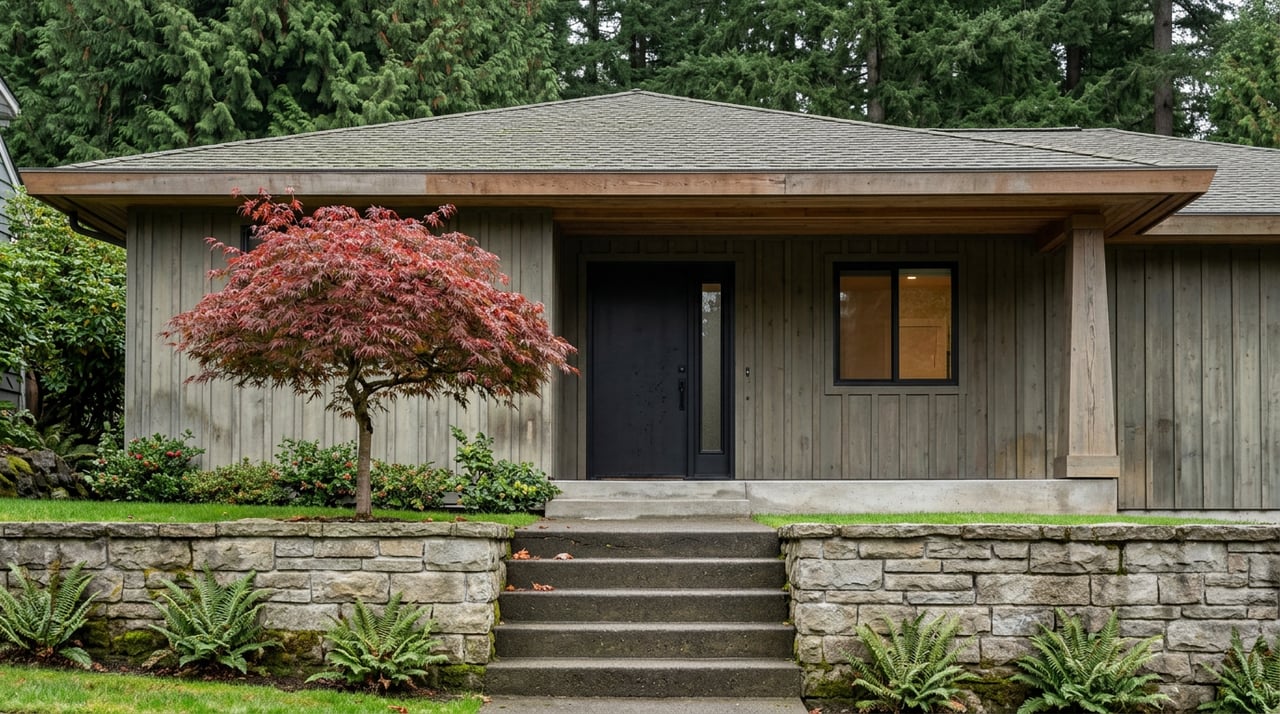
I once walked a buyer down a hillside street in Southwest Portland where two houses sat almost identically staged: same era, same square footage, same view of Douglas fir canopy out back. One had a poured sidewalk out front. The other had a gravel shoulder that dropped straight into a drainage ditch. The buyer asked why the second house was priced lower when it had the better lot. The honest answer had nothing to do with staging or finishes. It had to do with concrete, stormwater, and a piece of city code most buyers never read.
Southwest Portland is famous, in local planning circles, for having the worst sidewalk coverage of any part of the city. That is not a design choice or a matter of neighborhood character. It is the visible edge of a cost structure that follows the property, not just the street, and it shapes price and long-term ownership costs in ways a median sale price will never show you.
Why the Sidewalks Stop Where They Stop
The city's own explanation traces back to annexation. Portland absorbed large parts of unincorporated Multnomah County in the late 1970s and 1980s, and much of what came in was already built out without a complete sidewalk network. Southwest Portland and outer East Portland share that history, which is why a 2025 City Council resolution noted that of all Portland streets lacking proper sidewalks or pedestrian access, more than half sit in East Portland and Southwest Portland.
What makes Southwest different from East Portland is terrain. East Portland is flat. A missing sidewalk there is mostly a paving problem. Southwest Portland is hilly, and much of it falls under an MS4 stormwater designation, meaning runoff drains to creeks rather than into a piped system. Add a standard sidewalk and you typically have to add curbs, inlets, and a stormwater facility to keep that new impervious concrete from washing straight into Tryon Creek or Stephens Creek. That single design constraint has been enough to stall sidewalk construction across entire neighborhoods for decades, and it is why a 2024 exchange between transportation advocates and city permitting staff described the West Portland Town Center area as lacking the formal stormwater facilities a new sidewalk network would require.
The cost difference is not small. Reporting on the sidewalk funding debate found that building a mile of sidewalk in Southwest Portland can run roughly ten times what it costs in outer East Portland, precisely because of the stormwater work hillside streets require. That is not a rounding error. It is the reason a street near a MAX station in outer East Portland can move up the construction list years before a comparable street in the SW Hills does, even when both have been waiting a long time.
During the same debate, District 4 Councilor Mitch Green made the underlying frustration explicit:
"How long should southwest Portland wait for sidewalks? Is it 50 years? Is it 100 years? Is it longer?"
The Code Most Buyers Never Read
Here is the part that actually affects your closing costs, not just your morning walk. Portland City Charter and City Code place the responsibility for constructing, maintaining, and repairing a sidewalk on the property owner whose lot it fronts, not on the city. That obligation, codified under Portland City Code 17.28.020, applies to homeowners, business owners, and homeowners' associations alike. The city can also require new sidewalk construction if the City Engineer determines one is needed, though in practice that authority is rarely invoked in already-developed neighborhoods.
A hillside lot without a sidewalk today is not neutral.
The same code cuts the other way even on streets that already have sidewalks. A 2026 legal guide on Portland sidewalk injury claims notes that Portland rules place significant sidewalk maintenance duties on the owner of the adjacent property, which means a cracked panel in front of a house you just bought can become your liability, not the city's, depending on the circumstances. None of this is legal advice. It is simply a reason to ask about the sidewalk in front of a Southwest Portland listing with the same seriousness you'd ask about the roof.
Money Is Coming, Unevenly
The city is not ignoring this. In May 2025, Portland City Council passed the Sidewalk Improvement and Paving Program, a plan to invest roughly $50 million per year in sidewalks, shoulder pathways, and pothole repair citywide, with a specific emphasis on Southwest and East Portland. The program was championed by District 1 Councilor Loretta Smith and District 4 Councilor Mitch Green, later joined by fellow District 4 Councilors Olivia Clark and Eric Zimmerman, and it deliberately keeps its funding language tied to Districts 1 and 4 rather than a citywide formula.
Fifty million dollars a year sounds substantial until you compare it to the backlog. The city's own pedestrian master plan analysis found approximately 350 miles of missing sidewalks along Portland's busiest streets alone, which the same report acknowledged is likely more need than the city can address in the next 20 years even with steady investment. SIPP is a real commitment, not a talking point, but it is not going to complete Southwest Portland's network on any homeowner's timeline. The Tryon-Stephens headwaters area and the West Portland Park neighborhood were named as priority zones under the LTIC-funded planning that preceded SIPP, and one concrete example is already moving: the SW Capitol Hill Road sidewalk infill project is in final design as of June 2026 and estimated for construction in late 2026, covering segments between SW 19th Avenue and SW Nevada Court and between SW 17th Avenue and SW Custer Drive.
If you are looking at a street inside one of these named priority corridors, that matters. If you are looking at a street outside them, the honest expectation is that nothing changes for years, possibly decades.
What the Price Data Is Actually Telling You
Here is where it gets interesting for anyone comparing numbers on a portal. Two Redfin snapshots of Southwest Portland from mid-2026 tell almost opposite stories depending on which price measure you use. Over the three months ending in May 2026, the median sale price in Southwest Portland was $680,000, down 2.9 percent from the same period a year earlier, with homes selling in about 23 days on 2 offers on average and a competitiveness score of 72 out of 100. But in the same Redfin report, updated in July 2026, the average Southwest Portland house price for the most recent month on record was $695,000, up 9.6 percent year over year.
A falling median alongside a rising average is not a contradiction. It is a sign the neighborhood is not one market. It is several. Infrastructure-complete pockets near the West Portland Town Center or inner SW Hills, where sidewalks, curbs, and stormwater systems are already in place, likely pull the average upward. Meanwhile, a wider band of hillside inventory without that infrastructure, priced for what it actually offers today rather than what it might offer someday, pulls the median down. The median price per square foot, at $325 as of the three months ending May 2026, up 3.8 percent year over year, sits closer to the middle of that split. None of this shows up if you only look at one headline number.
Three Questions Worth Asking Before You Fall for the Quiet Street
- Does this specific street have a sidewalk, and if not, is it inside a named SIPP priority area like the Tryon-Stephens headwaters or West Portland Park, or a funded project like SW Capitol Hill Road?
- Is there a stormwater facility serving this lot, or does runoff drain to a stream, which is the underlying reason many Southwest streets can't simply add concrete?
- What triggers a frontage improvement here, and has the property had any development review history that might have already started that clock?
None of these questions will show up on a listing sheet. They come from knowing how the city actually builds, or fails to build, its pedestrian network, and from treating a quiet, sidewalk-free street as a financial question rather than a lifestyle preference.
Frequently Asked Questions
Does a Southwest Portland listing have to disclose that a street lacks a sidewalk? Missing sidewalks are visible on any showing, but the future obligation attached to that lot is not something a standard walkthrough reveals. Verifying frontage improvement history and stormwater status is worth doing before you write an offer, not after.
Will SIPP funding reach every Southwest Portland street eventually? The program directs real money toward Districts 1 and 4, but the city's own pedestrian plan puts the citywide backlog at roughly 350 miles of missing sidewalk on major streets alone. Priority corridors like Tryon-Stephens and West Portland Park are more likely to see near-term work than side streets outside those boundaries.
Is a sidewalk-free lot always a bad buy? Not at all. It can mean a lower entry price for the same square footage and a quieter street. The point is to price that trade-off deliberately, factoring in the sidewalk obligation and stormwater question, rather than discovering it later during a remodel or a resale conversation.
If you are weighing a Southwest Portland listing and want a second set of eyes on what a specific street's infrastructure history actually means for your offer, I am glad to walk it with you. Kristen Anzellotti has spent two decades reading Portland-area streets the way other people read spreadsheets. Let's Connect.